Service & validation

Specialized Validation & Services

Validating a containment system requires specialized physical tests that go beyond standard lab instrument calibration:

High-Efficiency Filter Integrity Testing (DOP/PAO Test)

HEPA and ULPA filters must be tested upon installation and periodically thereafter to ensure there are no leaks in the filter media or around the housing seals. An aerosol challenge (typically using Polyalphaolefin or Dioctyl Phthalate) is introduced upstream, and the downstream face is scanned to verify a minimum particulate filtration efficiency (e.g., 99.97% or higher).
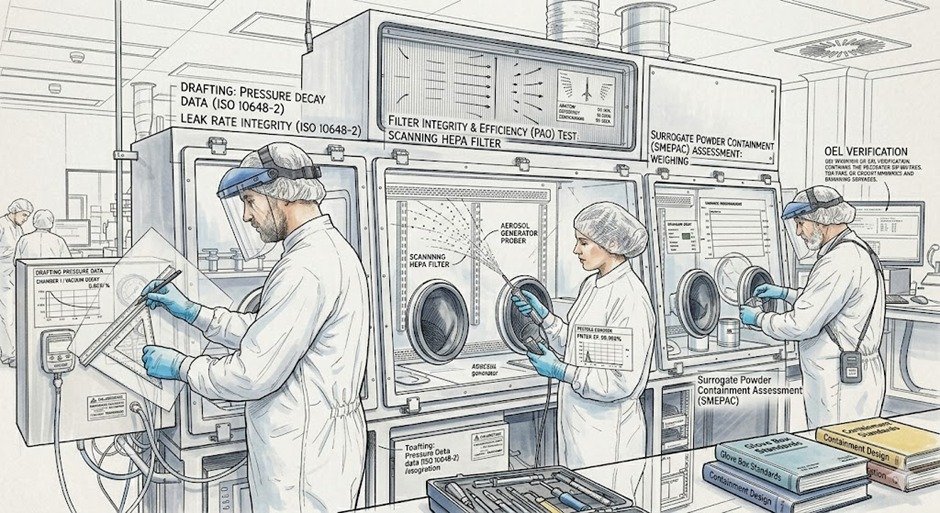
Containment Leak Integrity Testing (ISO 10648-2)

Glove boxes and isolators must pass rigorous leak tests to evaluate their physical hermetic seal.

  • Pressure Decay Method: The enclosure is pressurized to a target setpoint, isolated, and the rate of pressure drop is monitored over a specified timeframe to calculate the hourly leak rate.
  • Oxygen Permeation Method: For systems operating under an inert atmosphere (such as nitrogen or argon), the rate of oxygen ingress is measured to ensure oxygen levels stay safely below required limits (often ).

Surrogate Powder Containment Assessment (SMEPAC)

To validate operator safety when handling hazardous substances, a surrogate containment test (following SMEPAC guidelines) is conducted. A low-toxicity surrogate powder, like lactose or naproxen, is manipulated inside the enclosure. Air sampling monitors placed outside the unit and near the operator’s breathing zone verify that the airborne concentration remains well below the target Occupational Exposure Limit (OEL).

Essential Maintenance and Lifecycle Services

To prevent containment breaches and ensure continuous compliance, a structured maintenance program is necessary:

  • Preventive Maintenance (PM): Scheduled replacement of high-wear components, including glove-port O-rings, window gaskets, and pre-filters. PM protocols also include inspecting gloves for micro-tears using automated glove leak testers.
  • Emergency Breakdown Support: Rapid deployment for critical failures, such as fan motor burnouts or sudden pressure drops. Any major intervention—such as window or main gasket replacement—mandates a re-qualification loop (mini-OQ) before the enclosure is cleared for use with hazardous materials.
  • Safe-Change Filter Services: Specialized technicians manage the replacement of contaminated exhaust filters utilizing Bag-In/Bag-Out (BIBO) housings, ensuring toxic residues remain sealed and isolated from the lab environment during maintenance.

Documentation and Regulatory Compliance

All service and validation activities must produce a comprehensive paper trail to withstand regulatory audits:

  • System Traceability: Every test instrument used during qualification (e.g., particle counters, anemometers, pressure gauges) must hold a current, NIST-traceable calibration certificate.
  • Data Integrity: If the enclosure utilizes an automated control system with digital data logging (such as chart recorders or PLC-driven audit trails), the system software must be validated to comply with 21 CFR Part 11, ensuring electronic records are secure, unmodifiable, and time-stamped.

Contact Us

If you`d like a free consultation, Please start by completing the form
Please enable JavaScript in your browser to complete this form.