Training workshops

Masterclass Training Workshop: Containment Control & Barrier Technology in Oncology/Cytotoxic Labs

Workshop Overview

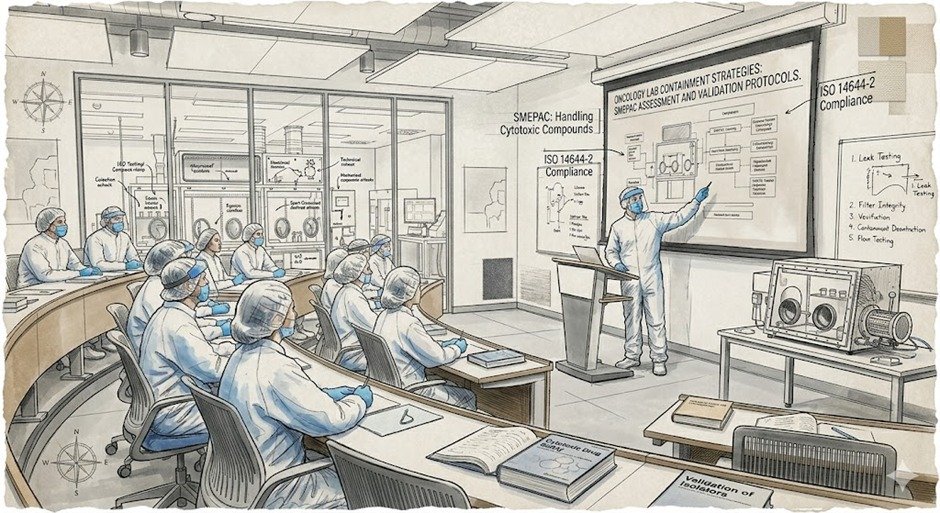
Handling hazardous substances in oncology research and quality control requires specialized engineering and strict compliance to guarantee operator safety. This intensive training workshop is designed for laboratory managers, validation engineers, and safety officers working with highly potent active pharmaceutical ingredients (HPAPIs), cytotoxic drugs, and targeted oncology formulations.

The program bridges the gap between theoretical fluid dynamics and the practical, day-to-day operation, maintenance, and validation of advanced barrier systems.
Workshop Modules

Module 1: Fundamentals of Cytotoxic Containment & Risk Assessment
  • Toxicological Foundations: Understanding Occupational Exposure Limits (OELs) and Short-Term Exposure Limits (STELs) specifically for genotoxic and cytotoxic compounds.
  • Aerosol Mechanics: Analyzing how microscopic airborne powders and liquid droplets behave under different laboratory air currents.
  • Negative vs. Positive Regimes: Selecting the correct pressure differentials to balance operator protection (negative pressure) with product sterility (positive pressure).
Module 2: Advanced Equipment Operation & Ergonomics
  • Glove Box & Isolator Dynamics: Mastering the physics of airflow velocity, unidirectional laminar flow, and boundary layer maintenance.
  • Ergonomic Best Practices: Developing proper manipulation techniques through heavy-duty glove ports (Butyl, EPDM) to reduce operator fatigue and minimize the risk of mechanical breach.
  • Airlock Management: Standard Operating Procedures (SOPs) for pass-boxes, antechambers, and Rapid Transfer Ports (RTPs) to ensure zero-leak material ingress and egress.
Module 3: Hands-On Lifecycle Services & Maintenance
  • Predictive & Preventive Maintenance (PM): Developing routine inspection checklists for window seals, glove-port O-rings, and structural integrity.
  • Safe Filter Management: Comprehensive training on Bag-In/Bag-Out (BIBO) exhaust filter replacement strategies to avoid exposing maintenance personnel to hazardous oncology residues.
  • Glove Integrity Testing: Utilizing automated positive/negative pressure decay methods to detect micro-tears in barrier gloves before operations begin.
Module 4: Regulatory Compliance & Validation Framework
  • The 4Q Lifecycle Protocol: Executing and documenting Design (DQ), Installation (IQ), Operational (OQ), and Performance (PQ) Qualifications according to ISO 14644 and ISO 10648-2.
  • Physical Verification Testing: Understanding the execution of High-Efficiency Filter Integrity Testing (DOP/PAO testing) and oxygen permeation methods.
  • SMEPAC Containment Assessment: Reviewing surrogate powder protocols (e.g., using lactose or naproxen) to empirically verify that the enclosure meets target exposure limits during active handling.

Interactive Workshop Features

  • Participants will observe and analyze airflow visualization studies to identify potential turbulent zones or stagnant air pocket vulnerabilities within standard enclosures.
  • Emergency Breach Drills: Interactive tabletop and physical simulations detailing immediate corrective actions during sudden pressure loss, glove punctures, or containment failure.
  • Data Integrity & Audit Preparation: Practical exercises on navigating PLC-driven control systems, managing electronic audit trails, and generating compliant documentation under 21 CFR Part 11 guidelines.

Key Learning Outcomes

By the conclusion of this workshop, attendees will be fully equipped to:

  1. Design airtight standard operating procedures that mitigate cross-contamination.
  2. Audit and evaluate existing containment hardware against international regulatory updates.
  3. Execute or oversee critical validation testing, ensuring the facility is prepared for comprehensive regulatory inspections.

Contact Us

If you`d like a free consultation, Please start by completing the form
Please enable JavaScript in your browser to complete this form.